Sometimes, the most meaningful lessons are the ones our students teach us!
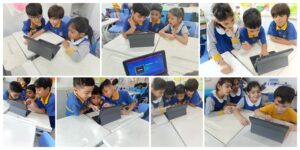
Last week, our Grade 1-C classroom was buzzing with excitement as we explored the topic “Habitats in Our Environment.” But this time, we did not begin with textbooks. Instead, we handed our young explorers tablets and gave them a mission: “Discover where these living things belong!”
Working in small research teams, students explored the habitats of peacocks, acacia trees, llamas, dung beetles, clownfish, moss, jasmine, roses, bulrushes and toads.
Their excitement was contagious!
“Miss, look! Clownfish live in the sea!”
“Miss, moss grows on wet rocks!”
For those fifteen minutes, they were not simply listening to information; they were exploring, questioning and discovering. This was Project-Based Learning in action!
When Students Changed the Plan!
After the exploration, we moved on to a group sorting challenge. I drew two large circles on the board: WET and DRY. The task seemed simple. We began placing the living things into their respective habitats.
However, our little researchers had a different idea!
One student confidently said, “Miss, the toad lives in BOTH! It swims in the wet but jumps on dry land!”
Another added, “Miss, moss is wet, but I have also seen it growing on our garden wall!”
Suddenly, my neat two-circle activity needed a rethink!
Instead of correcting their ideas or sticking to my original plan, I decided to build on their thinking. We created something new: “The Animal Neighbourhood – Where Friends Meet!”
Using blue paper for wet habitats, yellow paper for dry habitats and a green bridge connecting them, students created a shared space. The toad found its place on the bridge, while moss was positioned where the two habitats met.
Through this simple, hands-on activity, children began to understand that habitats are not always separate spaces. Some living things depend on more than one environment to meet their needs.
The Most Beautiful Part of the Lesson
What stayed with me was not just the completed activity, but the thinking behind it. The children questioned, shared ideas, listened to one another and suggested possibilities beyond the original task.
This experience reminded me that meaningful learning happens when we give children the freedom to explore and the confidence to express their ideas. Technology opened the door to discovery, but their curiosity and collaboration made the learning meaningful.
As part of our Blog Writing Initiative at Beaconhouse Suparco Road Campus, I am excited to share this classroom experience because it reflects what teaching is truly about: creating opportunities for children to think, discover and grow.
I walked into the classroom with a lesson plan, but I walked out with a lesson learned from my students!
Have your students ever surprised you with an idea that changed your lesson? Sometimes, their little ideas build the biggest bridges!