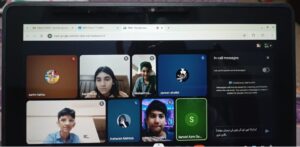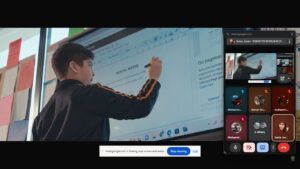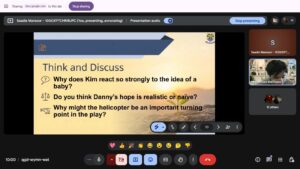
There was a time when effective teaching could be measured by visible cues, raised hands, attentive faces, the quiet hum of a focused classroom. Online learning disrupted that almost overnight. Suddenly, engagement was no longer something you could see; it was something you had to sense.
And so began a quiet redefinition of teaching.
As we navigated the rhythms of virtual classrooms, a new culture began to emerge–cameras on, microphones off, and somewhere between “Can you hear me?” and “You’re on mute,” learning took on a different form. Attendance was easy to record; attention was not.
Yet, what could have remained a limitation, became an opportunity. Our educators chose not to replicate the physical classroom on screen, but to rethink it entirely.
Online teaching demanded more than content delivery. It required presence without proximity and connection without certainty. Teachers found themselves reading between silences, pauses, and chat box replies–adapting not by lowering expectations, but by redesigning their approach.
Classrooms became more interactive, not less. Polls replaced raised hands, breakout rooms encouraged quieter voices, and chat spaces allowed even the most hesitant learners to participate. Platforms like Nearpod, Kahoot, Google Classroom, and Padlet were used to create interactive, student-centered experiences, turning screens into spaces for collaboration rather than passive listening. What seemed like barriers, gradually became tools.
Teaching also became more intentional. Without the structure of a physical classroom, clarity was essential, every instruction sharper, every activity purposeful, every moment designed with care.
There were challenges, unstable connections, delayed responses, and the unpredictability of learning from home. Yet these moments humanized the experience, reminding us that behind every screen was a student with a unique context.
In response, our educators balanced empathy with rigor. They upheld expectations while creating spaces where students felt seen, even when they were not always visible.
Effective online teaching, then, is not defined by perfect conditions. It is defined by adaptability, connection, and thoughtful practice.
The medium may have changed, but the essence of teaching has not. If anything, it has become clearer.