By Ms. Benish Adnan
For years, I wore the “laptop teacher” badge with pride. My lessons had it all — YouTube clips, online quizzes, online worksheets. If it plugged in, I used it. I was convinced I was giving my students a head start on the future.
Then I had a total mindset shift.
I signed up for a professional development course on digital technologies expecting a list of new apps to try. What I got instead was a new way to see. I realized there’s a world of difference between using technology and integrating it with purpose. Understanding that gap changed everything for my classroom, my students, and me.
My Lightbulb Moment: Tech Is Not the Lesson
My old lesson planning was predictable:
Objective → Find a worksheet → “How can I add some tech to make this fun?”
Now I start with a different question:
Objective → “What can technology let my students do that paper can’t?”
That one question reframed everything. It turned tech from decoration into design. Kahoot is the perfect example. It used to be my Friday treat to boost engagement. Now it’s my real-time diagnostic tool. I can spot misconceptions in the moment and reteach before students even leave the room. Same app. Completely different purpose.
The Classroom Transformation I Didn’t Expect
Once technology had a clear role, my students showed up differently. The 21st-century skills posters on my wall finally became real.
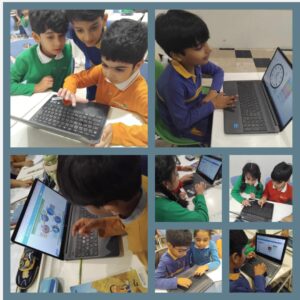
Collaboration became authentic. My students co-created eBooks on Book Creator with peers from another school. I listened to them negotiate word choice, debate layouts, and fact-check each other like a real publishing team. It was chaotic, loud, and exactly what learning should sound like.
Creativity found a purpose. We moved away from journal entries that lived and died in notebooks. Instead, students designed digital posters and presentations on Canva to teach a concept to younger students. When your audience is a real Grade 2 class, you care about clarity, design, and accuracy. The work left our room, and their pride skyrocketed.
Critical thinking became visible. I replaced solo worksheets with collaborative Google Docs for problem-solving. Suddenly I could see their thinking in real time, the drafts, the questions in comments, the revisions. I stopped guessing who was lost. I knew, and I could step in right when it mattered.
Communication went paperless and meaningful. Handwritten exit slips were replaced by a shared Google Doc. Students now give each other peer feedback. Because they know their words will be read by classmates, they write with purpose. Their comments have clarity, evidence, and voice.
These weren’t tech gimmicks. They were deeper, richer learning experiences that paper alone couldn’t deliver.
The Unexpected Win: My Own Teaching Transformed
I took that course for my students. I never imagined it would change me this much.
I reclaimed my time. Auto-graded forms, saved comment banks in Google Docs, and AI support for differentiation gave me 4+ hours back each week. I spend those hours conferencing with kids instead of drowning in marking.
I plan with intention now. Every tool has to pass one test: “Does this elevate the learning, or just digitize it?” If it’s simply a worksheet on a screen, it doesn’t make the cut. My lessons are fewer, but they’re stronger.
I feel like a designer again. Planning excites me. Watching a student analyze data they collected through a Google Form and explain their findings with confidence — or seeing them present a digital poster that genuinely teaches someone else — that’s why I became a teacher. I had forgotten that feeling. Teaching with purpose brought it back.
My New Non-Negotiables for EdTech
1. Pedagogy before platform. The learning goal chooses the tool. Every time.
2. Less is more. I’d rather go deep with one tool than skim the surface with ten.
3. Students as co-pilots. I ask them directly: “Did this tech help you learn?” Their feedback shapes what I do next.
The Real Takeaway
For years I said I was “integrating technology.” The truth? I was just using it.
Meaningful integration isn’t about having the newest device. It’s about pausing to ask: _“How can this tool give my students voice, choice, and skills they’ll actually need in 2035?”
When you get that right, technology stops being another item on your to-do list. It becomes the thing that removes items from your list — while helping your students soar.
It transformed my learners. It transformed me. And it can do the same for you.
Start small. Pick one lesson. Ask the magic question. See what happens.