
 There is a special kind of energy in a Grade 3 classroom during math stations. It’s not loud chaos — it’s purposeful buzz. Students are moving, thinking, negotiating, and solving problems without waiting for the teacher to rescue them. That’s the magic of well-designed rotations.
At the Addition Station, children become budget planners. They are given a pretend amount of money and a simple price list for classroom snacks or supplies. Very quickly, adding three-digit numbers feels important. “If we buy 18 juice boxes at 35 rupees each, how much will we spend?” They calculate, recheck, and sometimes realize they’ve gone over budget. The learning is immediate and meaningful.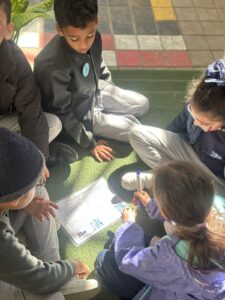 At the Multiplication Station, students build arrays using counters or blocks. Instead of memorizing 4 × 7, they physically create four rows of seven and see 28 appear in front of them. One child might connect it to arranging chairs for an assembly. Another may draw it on grid paper. Different strategies, same understanding.
The Division Station turns fairness into math. Twenty-four “cookies” must be shared equally among six “friends.” When the numbers change, so does the strategy. Students quickly see what equal groups really mean — and what happens when there’s a remainder.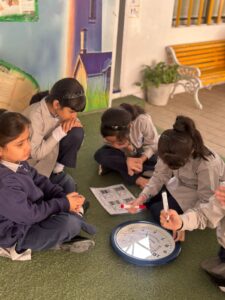 Then comes the Time Station. Using mini clocks, students calculate start and end times of classes or plan a daily schedule. Suddenly, elapsed time is not abstract; it’s their real school day.
With clear instructions and structured rotation, students learn to manage tasks, check answers, and collaborate. Math stations do more than teach operations — they build confident, independent thinkers.
Math Stations: Small Rotations, Big Independence
149 Views